

Why Fashion Brands Struggle With Inventory Availability and Fast Delivery
Fashion brands face a persistent gap between what retailers expect and what brands can actually deliver. Stock goes out of sync. Orders get delayed. Buyers lose confidence. At the core of most of these issues is poor fashion inventory visibility, the inability to see, in real time, what is available, where it is, and when it can ship.

This is not a niche problem. It affects brands of all sizes, from regional labels to established national players. And as buyer expectations rise, the cost of getting it wrong keeps climbing.
This blog breaks down exactly why these challenges exist and what brands can do to address them.
The Root Causes of Inventory Availability and Delivery Failures in Fashion
Fashion operates on compressed timelines. A season has a window. Miss it, and the product loses relevance. Yet most brands are still running their operations on tools that were not built for that speed.
Several structural issues create the problem:
Disconnected systems: ERP data, sales rep inputs, and warehouse records rarely speak to each other in real time. Stock levels shown to a buyer may already be committed or physically unavailable.
Manual order processing: When order management clothing workflows depend on spreadsheets, emails, or phone confirmations, errors compound at every handover point.
Siloed channel data: Stock allocated to one region or channel often sits invisible to another, creating artificial shortages in one place and surpluses in another.
Seasonal demand mismatch: The bullwhip effect, where small swings in demand cause large distortions upstream, is a well-documented challenge in fashion supply chains.
According to NuOrder's 2024 State of Fashion analysis, volatility in consumer demand continues to pressure suppliers and create transparency gaps across the chain.
How Inventory Gaps Translate Into Delivery Failures
Poor fashion inventory visibility does not stay contained in the warehouse. It spreads quickly into delivery performance.
When a retailer order portal fashion system shows stock that is not actually available, orders get confirmed and then cancelled. When order confirmation happens manually, lead times stretch. When warehouse allocation is done from static data, the wrong depot ships or nothing ships at all.
The result is a cycle of reactive operations: brands fix problems after they occur rather than preventing them. Retailers lose trust. Repeat orders decline.
According to JOOR's research on real-time inventory in B2B operations, real-time stock visibility directly reduces over-ordering, backorder management overhead, and the need for markdowns, all of which are symptoms of the same upstream visibility failure.
What Fashion-Specific Challenges Make This Harder
Challenge | Why It Is Specific to Fashion |
High SKU count | A single style in multiple sizes, colours, and fits multiplies complexity exponentially each season |
Short selling windows | A style that sells in September is irrelevant by November, errors have no recovery time |
Multi-retailer coordination | Different buyers, pricing tiers, and regional allocations must be managed simultaneously |
In-season replenishment | Demand spikes mid-season require fast reorder capability that static systems cannot support |
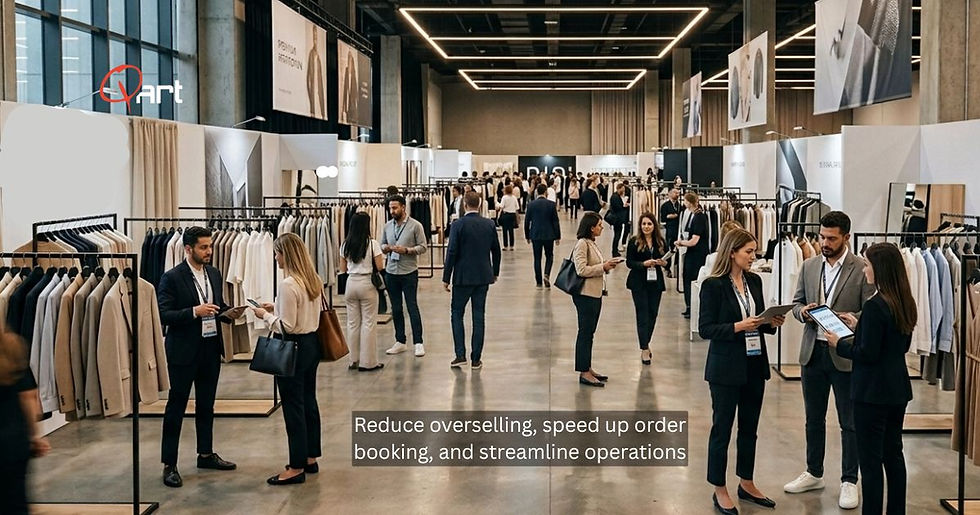
Tradeshow order volumes | Large order intakes over 3–5 days create data backlogs that manual processing cannot clear in time |
These are not general supply chain problems. They are structural features of fashion that make standard inventory tools insufficient.
Why Fashion Brands Need Dedicated B2B Infrastructure
A generic order management system was not designed for seasonal collections, tiered retailer pricing, or tradeshow-driven intake volumes. Fashion brands need b2b fashion software built specifically for how this industry operates.
This is where the distinction between a standard platform and a purpose-built B2B fashion Platform becomes important. A platform designed for fashion will handle:
Live inventory sync across all active retailers simultaneously
Retailer-specific catalog and pricing configurations
Automated order routing from booking to fulfillment
Real-time availability confirmation at the point of ordering
QartSolutions is built exactly for this model. The regular sales automation layer within QartSolutions connects inventory data directly to retailer ordering workflows, ensuring that what a buyer sees at the point of ordering reflects what the brand can actually ship.
The Role of Automation in Solving Inventory and Delivery Gaps
fashion in-season order automation is one of the most direct interventions a brand can make. When orders are placed, confirmed, and routed through an automated system, the manual handovers that introduce delays and errors are removed.
automated order management for fashion brands means:
Stock is reserved at the moment an order is placed, not after a sales rep follows up
Retailers receive real-time availability data without waiting for someone to check
Order confirmation, allocation, and dispatch are triggered by the system, not by a person
For brands managing a network of retailers across regions, this is not a convenience feature. It is the operational foundation that makes consistent delivery possible.
Shopify's analysis of B2B fashion ecommerce confirms that B2B buyers now expect the same instant inventory confirmation and order tracking they experience in direct-to-consumer channels and brands that cannot deliver it are losing orders to those that can.
What a Modern B2B Fashion Portal Enables
A b2b portal for fashion industry operations does more than display a digital catalog. It becomes the operational interface between the brand and every retailer in its network.
A well-configured fashion portal gives retailers the ability to browse live collections, check stock availability by size and colour, place orders directly, and receive immediate confirmation, all without requiring a sales rep in the loop for every transaction.
For the brand, it means:
Fewer errors from manual order entry
Faster order cycles with less administrative overhead
A consistent buyer experience regardless of region or retailer size
Clear data on which styles, sizes, and regions are performing in real time
This is what a B2B fashion portal is designed to deliver, and it is the infrastructure that separates brands with reliable delivery performance from those still chasing order confirmations by email.
For brands managing distributor networks or multi-region retailers, QartSolutions' order management for fashion distributors goes deeper into how centralised order tracking changes delivery outcomes at scale.
The Compounding Cost of Inaction
Fashion brands that delay this transition do not simply stay where they are. They fall further behind.
Retailers increasingly have options. A B2B fashion portal from one brand that shows live inventory, accepts orders at any time, and confirms availability instantly will win repeat bookings over a brand that requires back-and-forth emails to confirm a size run.
According to The Industry Fashion's 2025 inventory analysis, brands like Zara that have centralised inventory systems capable of real-time allocation are measurably outperforming those still operating on disconnected regional models.
fashion b2b order management is not a back-office function. It is a commercial capability. Brands that treat it as such, investing in the right retailer order portal fashion infrastructure, deploying fashion in-season order automation, and building on a purpose-built b2b fashion software stack are the ones that can commit to delivery timelines and honour them.
Conclusion
Fashion inventory visibility sits at the centre of every delivery failure and every missed order. It is the gap between what brands think they have and what they can actually ship.
Closing that gap requires more than better spreadsheets. It requires a dedicated fashion b2b order management system, real-time inventory sync across all channels, and a B2B fashion Platform built for the pace and structure of how fashion actually sells.
QartSolutions is designed to give fashion brands exactly that, a single, connected environment where inventory, orders, and retailer relationships are managed from one place, in real time.
If your brand is still managing availability and delivery through disconnected tools, the gap will keep growing. The infrastructure to close it exists. It is a decision to implement it.


Comments